Negative Google reviews can significantly influence customer trust, conversion rates, and local search performance. In 2026, Google Business Profile reviews are one of the strongest decision making factors for local and service based businesses.
However, there is a persistent misconception among business owners that negative reviews can simply be deleted or removed on request. In reality, Google does not remove reviews based on sentiment or dissatisfaction. Reviews can only be removed when they violate Google’s content policies, and even then, removal depends on evidence strength, review classification, and Google’s internal moderation systems.
This guide explains exactly how to remove negative Google reviews, how Google evaluates them, what actually works in real cases, and what experienced reputation management professionals do when removal is not possible.
Understanding How Google Reviews Work in 2026
To understand how to remove negative Google reviews, it is important to first understand how the system is designed.
Google Reviews is a trust based ecosystem built to reflect real user experiences. The primary objective is not to protect businesses but to provide transparency for users making purchasing decisions.
Because of this design, even negative feedback is often allowed to remain visible if it is based on a real interaction.
Google uses a combination of automated detection systems and manual review processes to evaluate flagged content. These systems analyze behavioral signals, content patterns, and account history to determine whether a review is legitimate or suspicious.
In practice, this means that removal is not subjective. It is entirely policy driven.
Can You Actually Remove Negative Google Reviews
Yes, but only under specific conditions.
Business owners cannot directly delete reviews from their Google Business Profile. The only way to remove negative Google reviews is by reporting them for violating Google’s content guidelines.
Even after reporting, removal is not guaranteed.
The critical distinction is this.
A review is not removed because it is negative.
A review is removed only when it violates policy and is supported by evidence.
This is the core principle that determines success or failure in almost all cases.
How Google Evaluates Review Removal Requests
When a request is submitted to remove negative Google reviews, it goes through multiple evaluation layers.
Google does not rely on a single factor. Instead, it evaluates a combination of automated systems and manual moderation depending on the complexity of the case.
Key evaluation signals include reviewer account credibility, historical activity patterns, review frequency behavior, geographic consistency, device and location signals, and linguistic patterns that match known spam or abuse behavior.
If the system cannot confidently determine the outcome, the case is escalated to human reviewers for manual assessment.
This is why some reviews are removed quickly while others remain unchanged even after repeated reporting attempts.
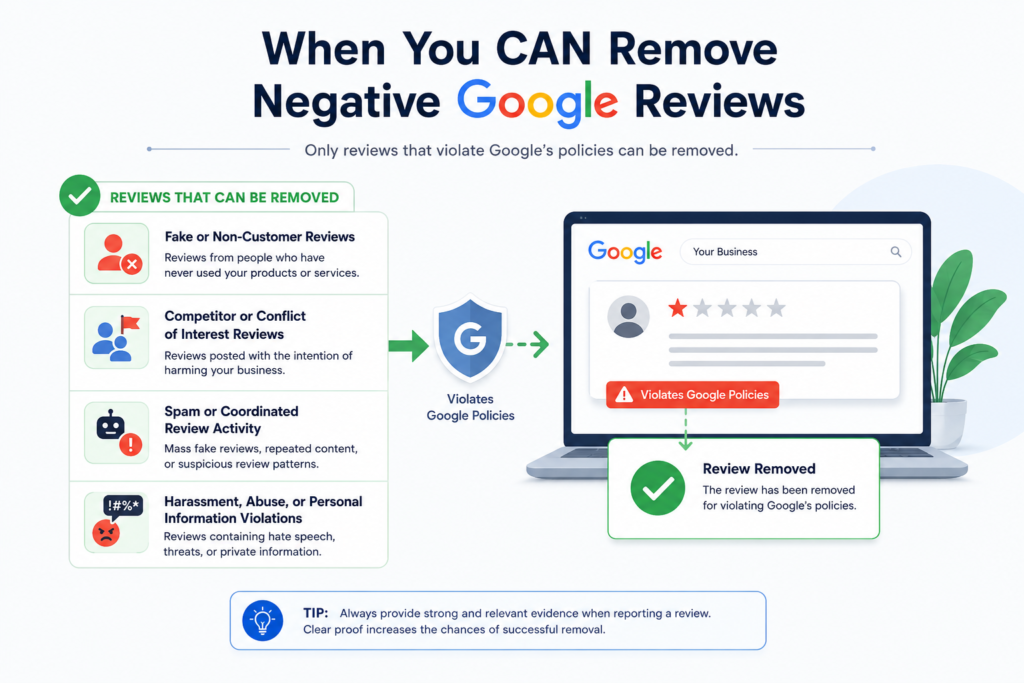
When You Can Remove Negative Google Reviews
There are only a limited number of policy based scenarios where removal is possible. These are strict and require supporting evidence.
Fake or Non Customer Reviews
One of the most common valid reasons for removal is when a review comes from a person who has never interacted with the business.
However, Google does not accept assumptions or verbal claims. The burden of proof is on the business.
In professional practice, strong evidence includes CRM records showing no customer match, invoice or billing system absence, appointment or booking system verification, and communication history checks such as calls, emails, or messages.
If no trace of interaction exists, the review becomes a strong candidate for removal. However, even partial interaction can lead Google to classify it as legitimate feedback.
Competitor or Conflict of Interest Reviews
Google prohibits reviews influenced by competition or personal bias.
However, this category is difficult to prove because intent is not always directly visible.
To successfully remove negative reviews in this category, businesses typically need indirect but strong signals such as competitor association patterns, coordinated review behavior across multiple listings, or identifiable conflict of interest indicators.
Without strong supporting evidence, these cases are often rejected due to lack of verifiable proof.
Spam or Coordinated Review Activity
Spam based review attacks typically appear in patterns rather than isolated cases.
Common indicators include sudden clusters of negative reviews within a short time period, repetitive or templated language across different accounts, newly created reviewer profiles with no history, and irrelevant or generic complaints unrelated to actual service experience.
Google’s spam detection systems in 2026 are significantly more advanced than previous years. However, manual reporting still plays an important role in borderline or mixed signal cases.
Harassment, Abuse, or Personal Information Violations
Reviews containing harassment or personal data are among the easiest to remove.
These include threats, abusive or discriminatory language, hate speech, or exposure of sensitive personal information such as phone numbers, addresses, or emails.
Google treats these cases as high priority because they violate user safety and platform integrity policies.
Reviews That Cannot Be Removed
A critical reality in reputation management is that most negative reviews cannot be removed.
If a customer has had a real interaction with your business, their review is generally considered valid content, even if it is critical, emotional, or unfair in tone.
This includes complaints about pricing, delays, service dissatisfaction, or unmet expectations.
Even if the business disagrees with the review, it remains protected under Google’s content policy as long as it reflects a genuine experience.
Understanding this limitation is essential before attempting to remove negative Google reviews.
Evidence Standards That Determine Success
Evidence quality is the most important factor in determining whether a removal request succeeds.
Strong evidence includes verified CRM data, transaction or invoice system records, communication logs showing no interaction, internal audits confirming non engagement, and behavioral patterns indicating spam or coordinated activity.
Weak evidence includes emotional disagreement, assumptions about reviewer identity, or statements without system verification.
In most failed cases, the issue is not Google denial but insufficient evidence quality.
Professional Workflow Used in Reputation Management
In real world practice, review handling follows a structured and methodical workflow.
First, the review is classified into categories such as fake, spam, competitor related, or legitimate feedback.
Next, internal systems are checked to confirm whether any customer interaction exists.
Then the review is mapped against Google policy definitions to confirm eligibility for removal.
If eligible, a structured report is submitted with supporting documentation.
Finally, the case is monitored and escalated only if additional evidence becomes available.
This structured approach is what professionals use to remove negative Google reviews efficiently and accurately.
Why Most Removal Requests Fail
Most businesses fail not because Google ignores them, but because the review does not meet policy violation criteria.
Common failure reasons include legitimate customer feedback being reported as fake, incorrect policy categorization, missing or weak evidence, emotional reasoning instead of structured proof, and misunderstanding of Google’s enforcement logic.
Google is designed to protect authentic user content, not to resolve business reputation disputes.
Risk and Compliance Considerations
An important but often overlooked factor is reporting misuse.
Repeated attempts to remove negative Google reviews without valid evidence do not improve success rates. In some cases, inconsistent reporting behavior may reduce the credibility of future requests.
This is why experienced reputation professionals only initiate removal when clear policy violations are present and documented.
What to Do When You Cannot Remove Negative Google Reviews
When removal is not possible, the strategy shifts from deletion to reputation management.
Professional responses play a critical role in shaping customer perception.
In many cases, improving your overall brand presence through Social Media Marketing Services helps reduce the impact of negative reviews by increasing positive engagement signals.
An effective response is calm, neutral, and solution oriented. It acknowledges the concern without emotional reaction, avoids arguments, and offers a private resolution channel.
This approach often has a stronger influence on future customers than the review itself.
In addition, businesses should focus on generating consistent positive reviews to balance overall reputation signals and improve trust ratios.
Business Impact of Negative Reviews
Negative reviews influence customer behavior more than they influence search rankings directly.
The most significant impacts include reduced trust before clicking on a business listing, lower conversion rates from search impressions, competitive disadvantage during comparison, and overall brand perception during decision making.
However, Google evaluates aggregated review patterns rather than isolated reviews. A strong profile with consistent positive feedback can absorb occasional negative reviews without significant impact.
Industry Specific Sensitivity
The impact of negative reviews varies by industry type.
Local service businesses are highly sensitive due to fast customer decision cycles. Hospitality businesses are influenced heavily by emotional experiences and subjective satisfaction. SaaS and digital businesses rely more on long term review trends and volume consistency rather than individual feedback.
Understanding industry behavior is essential for setting realistic expectations around review removal outcomes.
Frequently Asked Questions
Can you remove negative Google reviews?
You can remove negative Google reviews only if they violate Google’s content policies. Google does not remove reviews just because they are unfair or harmful. The review must clearly break rules such as spam, fake engagement, harassment, or conflict of interest.
How do I remove negative Google reviews from my business profile?
To remove negative Google reviews, you must report the review through your Google Business Profile. After reporting, Google evaluates the review using automated systems and sometimes manual review. If the review violates policy and evidence supports it, Google may remove it.
Why is Google not removing my negative review?
Google does not remove a review if it follows Google reviews Content policy guidelines. Most negative reviews are considered valid customer experiences, even if they are critical or unfair. If there is no clear policy violation or lack of evidence, Google will keep the review visible.
How long does it take to remove negative Google reviews?
It usually takes a few days to several weeks to remove negative Google reviews. The time depends on the complexity of the case, type of violation, and whether manual review is required.
Can fake Google reviews be removed?
Yes, fake Google reviews can be removed if you can prove there was no real customer interaction. Strong evidence includes CRM records, transaction history, booking system logs, or communication records showing no engagement.
What types of Google reviews cannot be removed?
Google does not remove reviews that come from real customer experiences. This includes complaints about pricing, service delays, dissatisfaction, or unmet expectations, even if the review is negative or emotional.
What is the fastest way to remove negative Google reviews?
The fastest way to remove negative Google reviews is to report reviews that clearly violate Google policies such as spam, fake accounts, or harassment. Reviews with strong evidence of violation are more likely to be removed quickly.
Does replying to negative Google reviews help SEO?
Replying to negative Google reviews does not directly improve rankings, but it improves trust and conversion rates. Professional responses help potential customers understand your business reputation and service quality.
Can competitors leave fake negative Google reviews?
Yes, competitors can sometimes leave fake reviews, but proving it is difficult. Google only removes such reviews if there is strong evidence of conflict of interest or coordinated activity.
What should I do if Google refuses to remove a review?
If Google refuses to remove a review, you should focus on reputation management instead. This includes responding professionally to the review, improving customer experience, and generating more positive reviews to balance your profile
Conclusion
Understanding how to remove negative Google reviews requires a clear understanding of Google’s policy driven system.
In 2026, only reviews that violate platform rules and are supported by strong evidence can be removed. Most legitimate customer feedback remains visible regardless of business preference.
The most successful businesses do not rely on removal as their primary strategy. Instead, they focus on delivering consistent customer experiences, maintaining professional responses, and building strong positive review ecosystems.
A strong online reputation is not built by eliminating criticism. It is built by earning sustained trust that outweighs occasional negative feedback.